


FOAM PRO food-handling gloves, size 10 – abrasion resistance level 4, 100°C
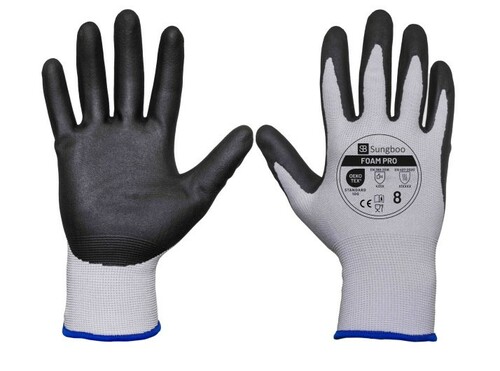


FOAM PRO – durability and versatility for everyday use
Grey polyamide gloves, coated with black foamed nitrile. Approved for direct contact with food. Resistant to contact heat. Suitable for the food industry, manual tasks, and warehouse work.

4 1 3 1 X
Protection against mechanical hazards

X 1 X X X X
Protection against contact heat

European conformity
Key benefits for your company:
Financial benefit
- Maximum mechanical strength: The highest available protection class (exceeding 8,000 abrasion cycles), ensuring exceptional resistance against the gloves wearing through or developing holes. This means that such issues do not occur during normal use.
- Designed for the toughest jobs: Designed for operations involving the highest levels of friction, such as metalworking, handling concrete elements or bricks, or working with sharp castings.
- Highest return on investment (ROI): The exceptional durability of these protective gloves—reaching level 4—allows for long-term use of each pair, even in the most demanding industrial environments.
Safety and standards
- Full compliance with EU standards: The gloves meet the requirements of Regulation (EC) No 1935/2004, guaranteeing their suitability for direct contact with food products.
- Sensory neutrality: Direct contact with food does not affect the aroma or taste of food products, which is crucial in food processing.
- Support for HACCP systems: Holding a health quality certificate facilitates the implementation and maintenance of hygiene and safety standards in manufacturing facilities, eliminating the risk of cross-contamination.
- Guaranteed time for safe contact: In accordance with the EN 407:2020 standard, our products provide Level 1 protection against contact heat. This allows for safe contact with objects heated to 100°C for a duration of 15 seconds, without the risk of skin injury.
- Safety in thermal processes: An ideal solution for tasks involving the operation of machinery or the handling of hot components and semi-finished products - such as those made of plastic - that are within lower operating temperature ranges.
- Protection against burns: An effective thermal barrier for direct contact with hot objects at temperatures of up to 100°C.
- Stability of protective parameters: The gloves retain their mechanical properties and protective structure even during repeated contact with objects at temperatures of up to 100°C.
Comfort use
- Dermatological safety: A guarantee that every component of the glove - both the knitted fabric and the coating - has been tested for the presence of over 100 substances harmful to human health.
- Protection for sensitive skin: A product free from pesticides, chlorophenols, carcinogenic dyes, and heavy metals, which minimizes the risk of contact allergies and irritation.
- The highest textile standard: The certificate confirms that the production process is strictly monitored and the finished product meets rigorous human-ecological requirements that go beyond standard national regulations.
- User trust: The presence of the OEKO-TEX® label is a clear signal to the user that the manufacturer cares about their health and comfort, offering a product of the highest quality and chemical purity.
- 13G Stitch (Standard Industrial): A classic industrial weave. It provides optimal mechanical strength and comfort, serving as the standard for most general and mechanical tasks
Ecology and composition
- Verification of recycled material content: The RCS certificate provides concrete proof of the presence and exact quantity of recycled materials in the finished product.
- Transparent supply chain: It guarantees the continuity of information regarding the raw material – from the waste collection point and processing stages right through to the finished protective glove on your hand.
- Support for the circular economy: By choosing products with RCS certification, you actively support the reuse of resources and reduce the landfilling of industrial waste.
- Trust in environmental claims: RCS eliminates the risk of so-called "greenwashing," giving the buyer assurance that the eco-friendly origin of the gloves has been verified by an independent certification body.

Safe for food contact

Does not contain harmful substances or allergens
Are OEKO-TEX certified gloves better for allergy sufferers?
Yes. This certificate guarantees that the product is free from toxic and irritating substances that often cause skin reactions in cheap, uncertified work gloves.
What is the difference between the GRS and RCS certificate?
Both concern recycling, but GRS is more rigorous—in addition to material composition, it also verifies factory working conditions, water management, and the absence of harmful chemicals in production. RCS focuses solely on verifying the quantity of recycled material in the product.
Do gloves with a higher level of abrasion resistance (Level 4) actually reduce company costs?
Definitely. Higher abrasion resistance (exceeding 8,000 cycles) means that a single pair of gloves lasts significantly longer than standard models. This allows for less frequent replacement of stock, resulting in tangible savings for the health and safety budget.
Can gloves approved for food contact be used with chemicals?
Not necessarily. A "food contact" certification confirms that the gloves do not transfer harmful substances to food. For work involving chemicals, you should always check the resistance rating according to the EN ISO 374 standard (Type A, B, or C).
highest level of abrasion resistance, resistance to contact heat, maximum work comfort, food industry, manual work in a humid environment, warehouse work, intended for direct contact with food do not contain harmful substances


