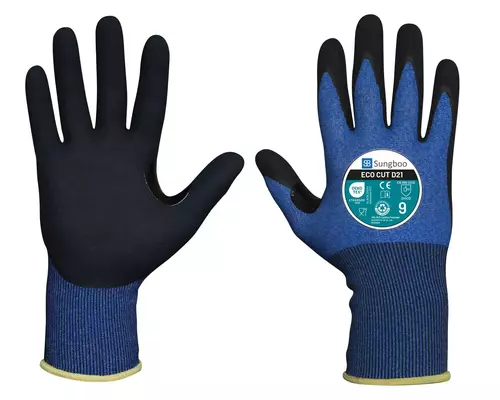
ECO CUT FOOD cut-resistant gloves, size 10 – level E, food-safe, RCS



ECO CUT FOOD cut-resistant gloves – for food contact
Sustainable product, eco-friendly cut-resistant gloves approved for direct food contact; made of HPPE fiber, steel fiber, recycled polyester, polyamide, and spandex; light blue, uncoated.
Regulation (EC) No 1935/2004

Safe for food contact
EN 388:2016

3X4XE
Protection against mechanical hazards
EN ISO 21420:2020

European conformity
Key benefits for your company:
Safety and standards
- A very high level of security: They provide effective hand protection in situations where the force exerted by a sharp edge on the material is up to 22 newtons (N).
- Barrier for work at industrial edges: They guarantee a high level of safety when working with sheet metal, glass edges, and very sharp tools.
- Reduction of the risk of deep injuries: Level E is designed for high-risk work environments where, in the event of an accident, standard mechanical protection is insufficient to prevent cut injuries..
- Full compliance with EU standards: The gloves meet the requirements of Regulation (EC) No 1935/2004, guaranteeing that the material is fully approved for direct contact with food products.
- Sensory neutrality: The material does not affect the odor or taste of food products, which is crucial in food processing and packaging operations.
- Support for HACCP systems: Holding the certificate facilitates the implementation and maintenance of hygiene and safety standards in production facilities, eliminating the risk of cross-contamination.
- Dermatological safety: A guarantee that every component of the glove—both the knitted fabric and the coating—has been tested for the presence of over 100 substances harmful to human health.
Comfort and durability
- Protection for sensitive skin: A product free from pesticides, chlorophenols, carcinogenic dyes, and heavy metals, which minimizes the risk of contact allergies and irritation.
- The highest textile standard: The certificate confirms that the production process is strictly monitored and that the finished product meets rigorous human-ecological requirements that go beyond standard national regulations.
- User trust: The presence of the OEKO-TEX® label is a clear signal to the user that the manufacturer cares about their health and comfort, offering a product of the highest quality and chemical purity.
- 13G stitch (Standard Industrial): Classic industrial weave. It ensures optimal mechanical strength and comfort, serving as the standard for most general and mechanical tasks.
Financial benefit
- Extended product lifespan: High abrasion resistance ensures that the gloves retain their protective properties significantly longer than standard models.
- An effective barrier for rough surfaces: Designed for use with materials having a rough texture, such as wood, plastics, or prefabricated elements.
- Optimization of OHS costs: Thanks to increased abrasion resistance, the frequency of glove replacement is reduced, generating real cost savings for corporate health and safety departments.
Ecology and composition
- Verification of recycled material content: The RCS certificate provides concrete proof of the presence and exact quantity of recycled materials in the finished product.
- Transparent supply chain: It guarantees the continuity of information regarding the raw material – from the waste collection point and processing stages right through to the finished protective glove on your hand.
- Support for the circular economy: By choosing products with RCS certification, you actively support the reuse of resources and reduce the landfilling of industrial waste.
- Trust in environmental claims: RCS eliminates the risk of so-called "greenwashing" by giving the buyer assurance that the eco-friendly origin of the gloves has been verified by an independent certification body.
Recycled Claim Standard Planet-friendly product
.png) Does not contain harmful substances or allergens
Does not contain harmful substances or allergens
Are OEKO-TEX certified gloves better for allergy sufferers?
Yes. This certificate guarantees that the product is free from toxic and irritating substances that often cause skin reactions in cheap, uncertified work gloves.
Can food-contact gloves be used with chemicals?
Not necessarily. A "food contact" certification confirms that the gloves do not transfer harmful substances to food. For work involving chemicals, you should always check the resistance rating according to the EN ISO 374 standard (Type A, B, or C).
What is the difference between GRS and RCS certification?
Both standards relate to recycling, but GRS is more rigorous: in addition to material composition, it also verifies factory working conditions, water management, and the absence of harmful chemicals in production. RCS focuses exclusively on verifying the quantity of recycled material in the product.
manufactured with respect for the natural environment and the health of customers by using recycled yarn, manual, very high level of cut resistance (E), good abrasion resistance, food industry, automotive, household appliances, metal, paper industry, warehouse work with sharp edges of goods, intended for direct contact with food